Research Interests, Projects & Highlights
Highly Accurate Coupled-Cluster Methods
My research interest include developements and applications of highly accurate coupled-cluster methodologies, with particular emphasis on electronic properties and diagnostic tools for assessing wavefunction quality and electronic-structure character.
A notable example is my work on the calculation of spin contamination in approximate wavefunction based on an unrestricted reference, highlighted in the article “Spin contamination in MP2 and CC2, a surprising issue” .
Finite-Magnetic-Field Coupled-Cluster Theory
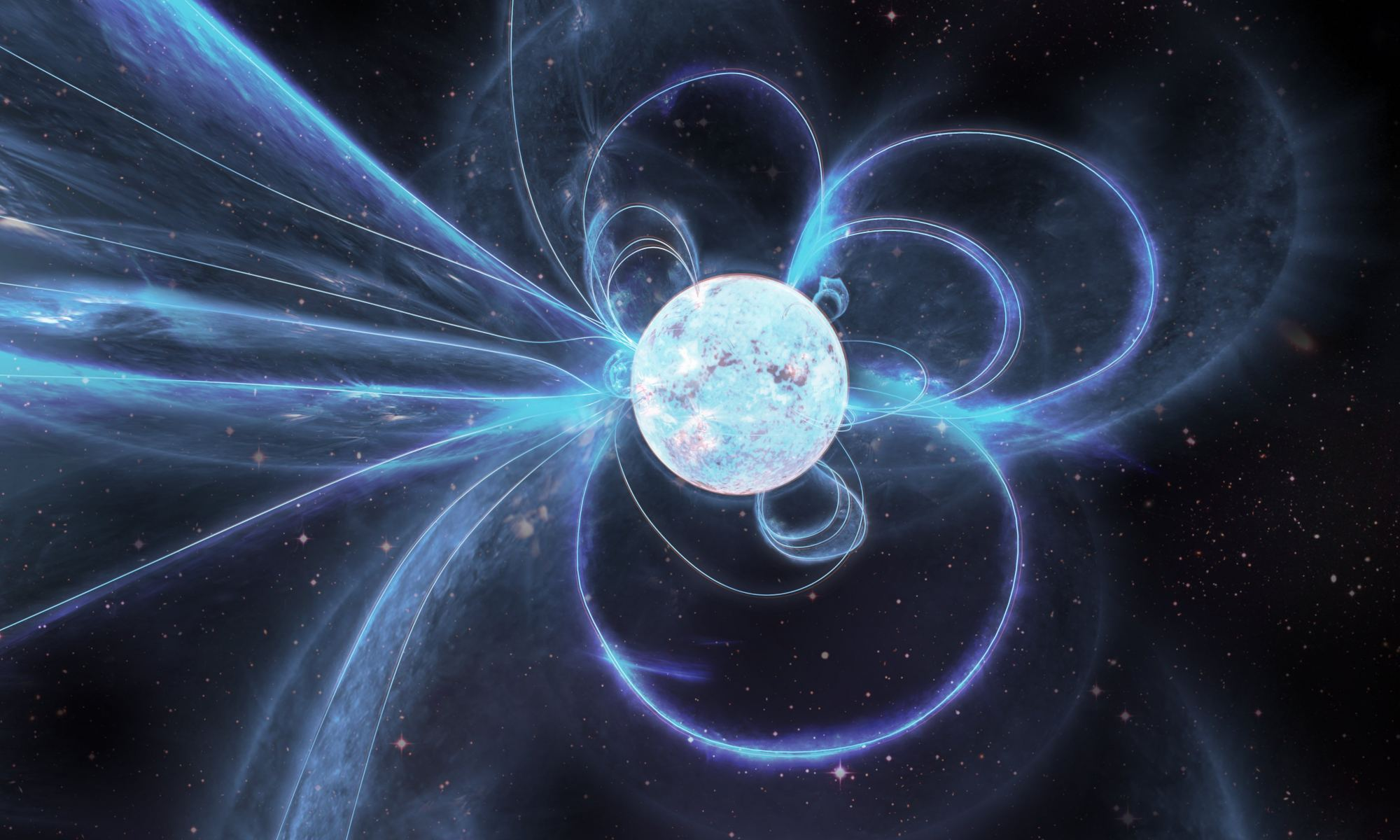
I have developed and applied coupled-cluster approaches in the presence of strong magnetic fields, enabling the accurate interpretation of spectra originating from magnetic White-Dwarf stars. The finite-magnetic-field formulation employed in this line of work requires the use of complex-valued algebra, which substantially increases the computational cost. A central aspect of my research therefore focuses on the development of coupled-cluster approximations and their efficient implementation as to retain high accuracy while remaining computationally tractable.
Key contributions in this direction include the generalisation of existing models that account for perturbative triples corrections in the finite-magnetic-field framework, as demonstrated in “The approximate coupled-cluster methods CC2 and CC3 in a finite magnetic field” and “Equation-of-motion coupled-cluster variants in combination with perturbative triples corrections in strong magnetic fields” .
Building on these methodological developments, my work has enabled the assignment of spectroscopic signatures arising from metal atoms in a strongly magnetic White Dwarf for the first time, as reported in “A DZ white dwarf with a 30 MG magnetic field” .
Green’s Functions and Coupled-Cluster Connections
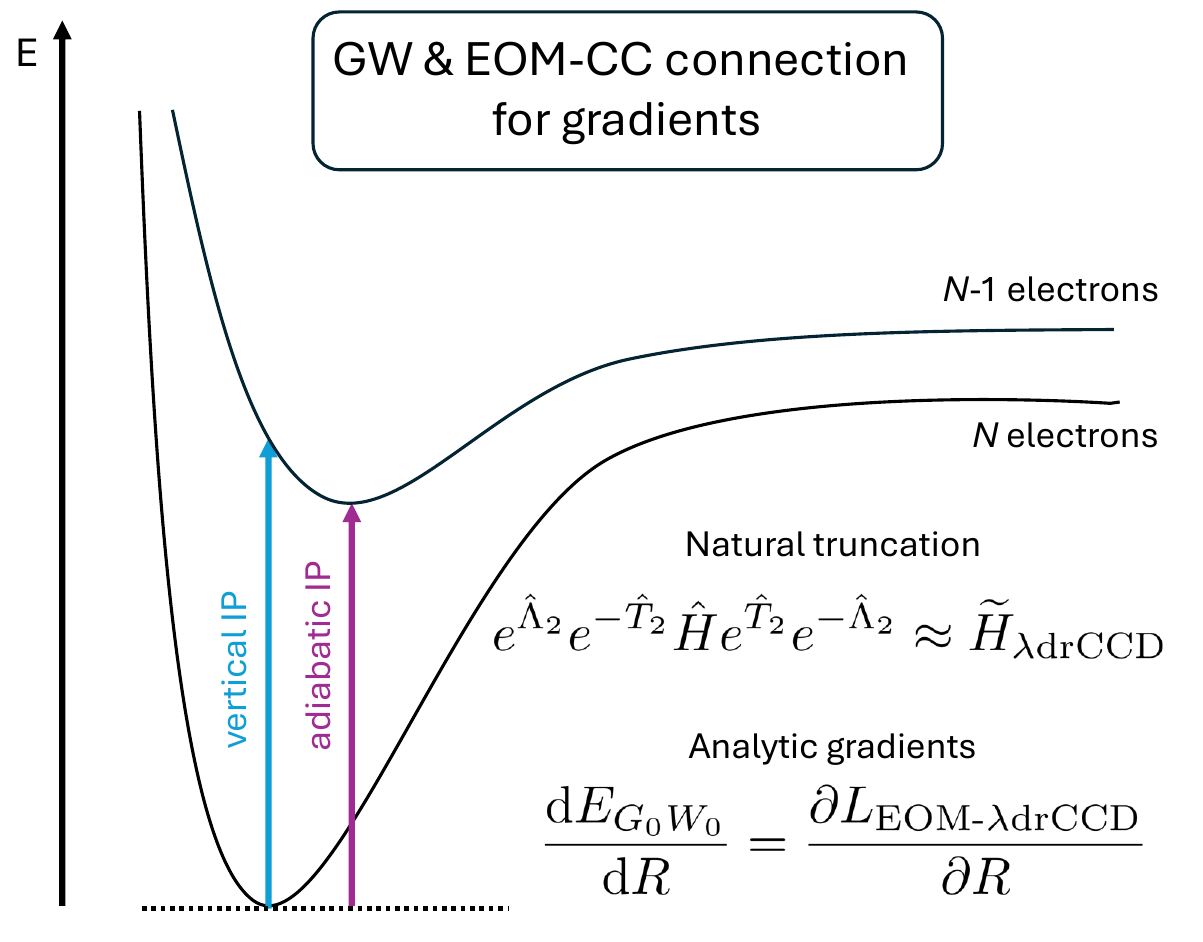
More recently, I have expanded my expertise to Green’s function approaches. These methods offer a powerful combination of efficiency and accuracy for the study of charged systems through the GW approximation and of electronically excited states through the Bethe–Salpeter equation (BSE). Importantly, they avoid the use of empirical parameters while achieving an accuracy comparable to coupled-cluster methods such as CCSD.
My background in both Green’s function methodologies and coupled-cluster theory allows me to exploit their intrinsic connections and to use this synergy as a platform for further methodological developments. A prominent example is my recent work on the implementation of analytic nuclear gradients at the G0W0 level of theory, as presented in “Analytic G0W0 gradients based on a double-similarity transformation equation-of-motion coupled-cluster treatment” .
I plan to further extend this line of research toward the combination of GW and BSE methods with molecular dynamics simulations, enabling the investigation of dynamical and finite-temperature effects in complex electronic systems.
Collaborators
- Prof. Dr. Stella Stopkowicz Saarland University, Germany
- Dr. Pierre-François Loos CNRS Toulouse, France
- Dr. Johannes Tölle University of Hamburg, Germany
Quantum Chemical Software


Curriculum Vitae
Education
- 2019–2023 | Ph.D. in Chemistry, Johannes Gutenberg University of Mainz, Germany (summa cum laude)
- 2016–2019 | M.Sc. in Chemistry, Free University of Berlin, Germany (very good)
- 2011–2015 | B.Sc. in Chemistry, University of Athens, Greece (excellent)
Advanced Training and Schools
- 2025 | Mini-school on Mathematics for Theoretical Chemistry and Physics (Machine Learning), GDR NBODY, Paris, France
- 2021 | Molecular Response Properties Summer School (MRPSS 2021), Stockholm, Sweden
- 2019 | European Summer School in Quantum Chemistry (ESQC 2019), Sicily, Italy
Professional and Academic Experience
-
2024–present | Postdoctoral Researcher in the group of
Dr. Pierre-François Loos
University of Toulouse, CNRS, Toulouse, France -
2023–2024 | Postdoctoral Researcher in the group of
Prof. Dr. Stella Stopkowicz
Saarland University, Saarbrücken, Germany -
2019–2023 | Scientific Staff Member, Theoretical Chemistry Group
(Ph.D. student supervised by Prof. Dr. Jürgen Gauss and Prof. Dr. Stella Stopkowicz)
Johannes Gutenberg University Mainz, Mainz, Germany
Presentations and Invited Talks
- 2025 | Poster presentation, “Analytic G0W0 gradients: An IP/EA-EOM-λ-rCCD reformulation”, 61st Symposium on Theoretical Chemistry (STC 2025), Berlin, Germany
- 2025 | Invited communication, “Towards Bethe–Salpeter equation excited-state gradients”, 13th Triennial Congress of the World Association of Theoretical and Computational Chemists (WATOC 2025), Oslo, Norway
- 2025 | Contributed talk, “Analytic G0W0 gradients: An IP/EA-EOM-λ-rCCD reformulation”, Interdisciplinary Conference on Many-Body Theory (NBODY 2025), Nancy, France
- 2025 | Poster presentation, “Analytic G0W0 gradients: An IP/EA-EOM-λ-rCCD reformulation”, Emerging Excited-State Methods in Electronic Structure 2025, Toulouse, France
- 2024 | Invited talk, “Geometry optimizations for ground and excited states using finite magnetic-field coupled-cluster theory”, Workshop New Developments in Coupled-Cluster Theory 2024 (Telluride Science Research Center), Telluride, USA
- 2024 | Poster presentation, “Geometry optimizations in the presence of strong magnetic fields: Rotational energy dependence of CH and C2 via coupled-cluster theory”, European Seminar on Computational Methods in Quantum Chemistry (Strasbourg Seminar, ESCMQC 2024), Copenhagen, Denmark
- 2023 | Poster presentation, “Atoms and molecules in the atmospheres of magnetic white dwarfs”, 17th International Congress of Quantum Chemistry (ICQC 2023), Bratislava, Slovakia
- 2021 | Poster presentation, “CC2 and CC3 methods in finite magnetic-field calculations”, 57th Symposium on Theoretical Chemistry (STC 2021), Würzburg, Germany
Teaching Experience
- 2025 | Tutor, Modern Wavefunction-Based Methods in Electronic Structure Theory Summer School (MWM 2025), Pisa, Italy
- 2024 | Tutor, European Summer School in Quantum Chemistry (ESQC 2024), Sicily, Italy
- 2023 | Tutor, Modern Wavefunction-Based Methods in Electronic Structure Theory Summer School (MWM 2023), Pisa, Italy
-
2023–2024 | Saarland University, Saarbrücken, Germany, tutorials and practica for:
- Theoretical Chemistry I, Theoretical Chemistry II, Chemistry in the Computer, Introduction to Quantum Mechanics, Physical Chemistry (Thermodynamics and Kinetic Gas Theory)
-
2019–2023 | Johannes Gutenberg University Mainz, Mainz, Germany, tutorials and practica for:
- Theoretical Chemistry I, Theoretical Chemistry II
-
2019–2023 | Co-supervision of Bachelor theses and research projects,
Johannes Gutenberg University Mainz, Mainz, Germany
- “Hochgenaue Equation-of-Motion Coupled-Cluster Methoden für Moleküle in starken Magnetfeldern” (Bachelor thesis, 2022)
- “Anregungen von Ethen und Ethin im magnetischen Feld” (Research project, 2020)
- “Moleküle in starken Magnetfeldern mit Coupled-Cluster Methoden” (Bachelor thesis, 2020)